

A B2B simulation software company serving automotive, healthcare, pharmaceutical, and aerospace markets increased its average monthly inbound enquiry volume from approximately 145 to 515 during the first nine months of an ongoing monthly SEO services engagement.
That's approximately 3.5x growth in monthly enquiries.
The engagement began as a monthly SEO programme and has continued beyond the initial nine-month performance period. As the work progressed, the strategy evolved based on performance data, search visibility, content opportunities, technical priorities, and the client's changing business needs.
The campaign focused on improving the website's technical foundation, strengthening existing industry and solution pages, improving international search visibility, and creating clearer paths from organic search to enquiry.
The results presented in this case study are based on the client's own HubSpot reporting. Client-identifying information has been omitted or anonymized where required for confidentiality.
Results at a Glance
Metric | Before | After 9 Months | Result |
Average monthly enquiries | ~145 | ~515 | ~3.5x growth |
SEO engagement | Starting point | 9+ months | Ongoing monthly engagement |
Market focus | - | Multi-market | International SEO |
Core industries | - | 4+ | Automotive, healthcare, pharmaceutical, aerospace |
The nine-month period represents the performance window highlighted in this case study, not the end of the engagement. The SEO programme continues on a monthly basis.
Client Snapshot
Industry: B2B simulation software and digital twin technology
Markets Served: Automotive, healthcare, pharmaceutical, aerospace, and other industrial applications
Engagement: 9+ months and ongoing monthly SEO engagement
Primary Objective: Increase organic visibility, improve existing content performance, and generate more consistent inbound enquiries
Service: SEO
Confidentiality: The client's name, domain, and other identifying information have been omitted or anonymized where required.
The Challenge: A Content-Rich B2B Website Wasn't Reaching Its Full Potential
The client already had a substantial digital presence covering multiple industries, solutions, markets, and languages.
The problem wasn't simply a lack of content.
The website had dedicated pages addressing specific industries and applications, including automotive manufacturing, healthcare, pharmaceutical, and aerospace use cases. It also had a presence across different geographic and language markets.
However, having a large content library does not automatically mean that search engines can efficiently crawl, understand, rank, and connect that content with commercial search intent.
Monthly inbound enquiry volume was averaging around 145 enquiries.
For a company serving multiple high-value B2B industries, there was an opportunity to generate significantly more value from the website's existing organic visibility. This is a common finding during a comprehensive SEO audit of large B2B sites.
The objective was therefore not simply to publish more content.
The objective was to make the existing website work harder as an organic acquisition channel.
What We Found
The initial SEO work focused on identifying where technical, structural, content, and conversion issues were limiting the website's performance.
Technical SEO
The website's size and multi-market structure made technical SEO an important part of the growth strategy.
The campaign examined the technical foundation and prioritized areas affecting crawlability, indexation, site architecture, and search visibility.
Content and On-Page Optimization
The client already had substantial industry-specific content.
Instead of treating every page as a reason to create another article, the strategy focused on improving pages that already had commercial and topical potential.
This included:
Search intent alignment
Keyword targeting
Page structure
On-page relevance
Internal linking
Industry-specific topical coverage
Commercial relevance
Relationships between related pages
A stronger link building foundation also supported these existing pages, reinforcing their authority rather than spreading equity across new, unproven content.
International SEO
The client's website served multiple markets and languages.
This created an additional SEO challenge: visibility needed to be built not only at a global level, but within the appropriate market and language context.
International SEO therefore formed part of the broader digital marketing services programme, helping relevant pages target the markets they were intended to serve.
Conversion Optimization
Traffic alone was not the end goal.
The campaign also considered what happened after a user arrived on an organic landing page.
Industry pages and high-value organic entry points were reviewed with the objective of making the path toward an enquiry clearer and more effective.
The focus shifted from:
More organic traffic
to:
More relevant organic traffic → more enquiries
The SEO Strategy: 9 Months of Growth and Ongoing Optimization
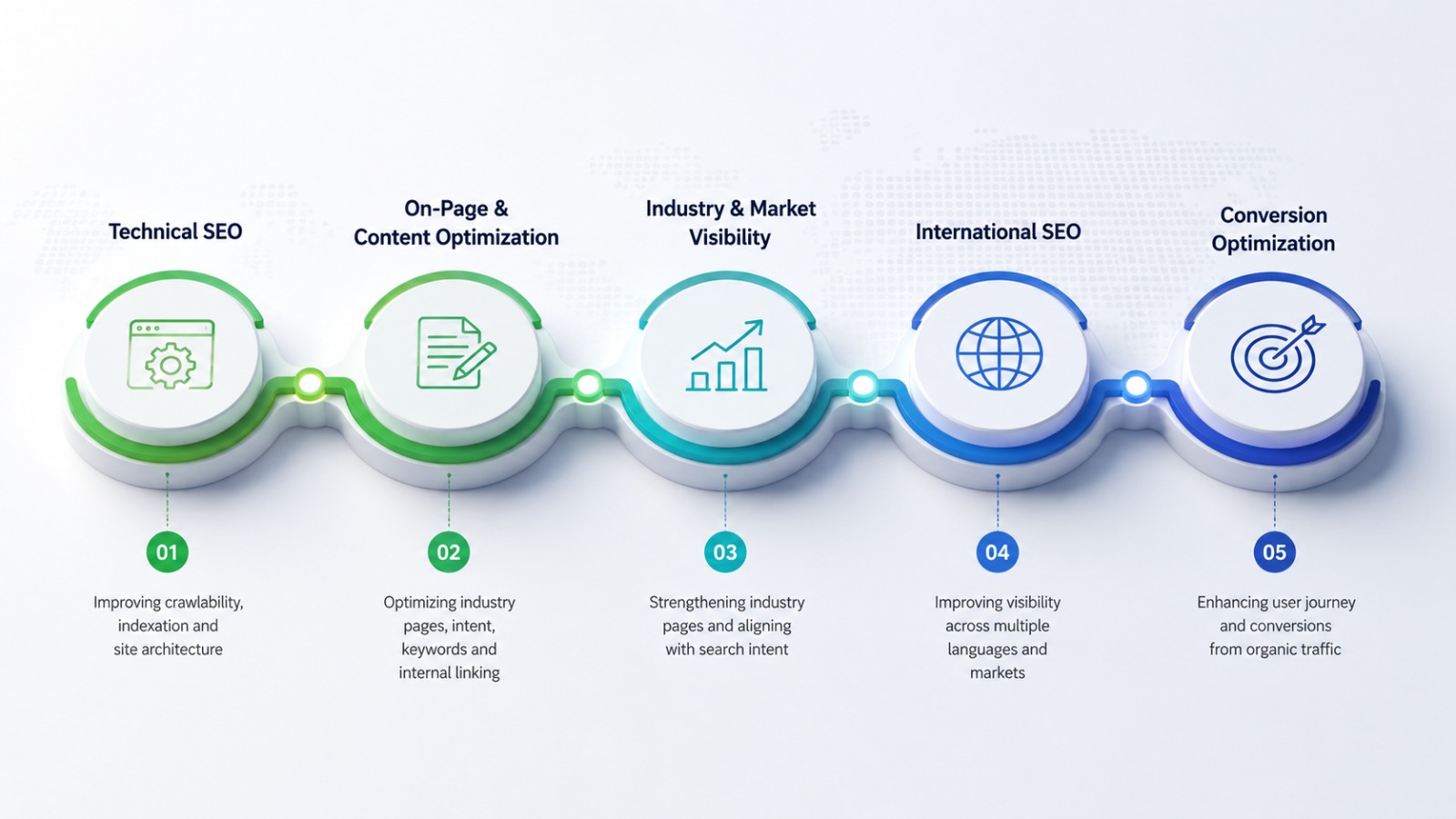
The engagement began with a structured SEO programme, but the strategy has continued to evolve on a monthly basis.
The first nine months provide the performance window highlighted in this case study. The work itself remains ongoing, with priorities adjusted as performance data, search behaviour, content opportunities, technical requirements, and business objectives change.
Phase 1: Technical Foundation
The first stage focused on understanding and improving the website's technical SEO foundation.
Key areas included:
Crawlability
Indexation
Site architecture
Internal linking
Page relationships
Technical barriers to search visibility
The goal was to make the website easier for search engines to discover and understand before scaling further optimization.
Phase 2: On-Page and Content Optimization
Once the technical foundation was being addressed, attention moved toward the website's existing content.
Industry and solution pages were reviewed based on:
Search demand
Search intent
Existing organic visibility
Commercial relevance
Topical authority
Internal linking opportunities
Rather than simply adding more pages, the campaign focused on extracting more value from content the client already had.
This was particularly important for a B2B website where individual industry pages can represent highly specific commercial search journeys.
Phase 3: Industry and Market Visibility
The website served multiple specialist industries, each with different terminology, applications, and search behaviour.
Pages targeting sectors such as automotive, healthcare, pharmaceuticals, and aerospace were therefore treated as distinct search opportunities rather than one broad topic.
This helped create a clearer relationship between:
Industry → Application → Solution → Search Intent → Enquiry
Phase 4: International SEO
The campaign also addressed the requirements of a multi-language, multi-market website.
International SEO efforts focused on helping relevant content reach the appropriate geographic and language audiences.
This included strengthening the relationship between localized content, search intent, and the markets being targeted.
For a global B2B company, visibility in the wrong market can be almost as unhelpful as having no visibility at all.
Phase 5: Conversion Optimization
The final piece was connecting organic visibility to business outcomes.
Landing pages receiving organic visitors were evaluated from a conversion perspective.
The objective was simple:
Don't just get the right person onto the page. Give them a clear next step.
Calls to action, enquiry paths, page messaging, and the transition from informational content toward commercial interaction were considered as part of the broader SEO programme.
Because the engagement remains ongoing, these areas can continue to be reviewed and refined as new performance data becomes available.
Industry-Specific SEO in Action
One important part of the campaign was the client's industry-specific content structure.
The website contained dedicated pages for sectors such as automotive, healthcare, pharmaceutical, and aerospace.
These pages provided an important foundation for capturing searches from users who were already thinking about simulation in the context of their particular industry.
The strategy treated these pages as important organic acquisition assets, connecting industry-specific search intent with relevant solutions and enquiry paths.
The Results: 3.5x Growth in Monthly Enquiries
During the first nine months of the ongoing SEO engagement, average monthly inbound enquiries increased from approximately:
145 to 515
That's approximately:
3.5x Growth
The significance of the result is not simply the percentage increase.
The important point is that the campaign was designed around organic acquisition and conversion, rather than optimizing for traffic volume alone.
The same underlying website became more effective at attracting relevant search users and moving them toward an enquiry.
The nine-month result represents a measured milestone within an ongoing monthly SEO programme, rather than the final outcome of a completed project.
HubSpot Reporting Evidence
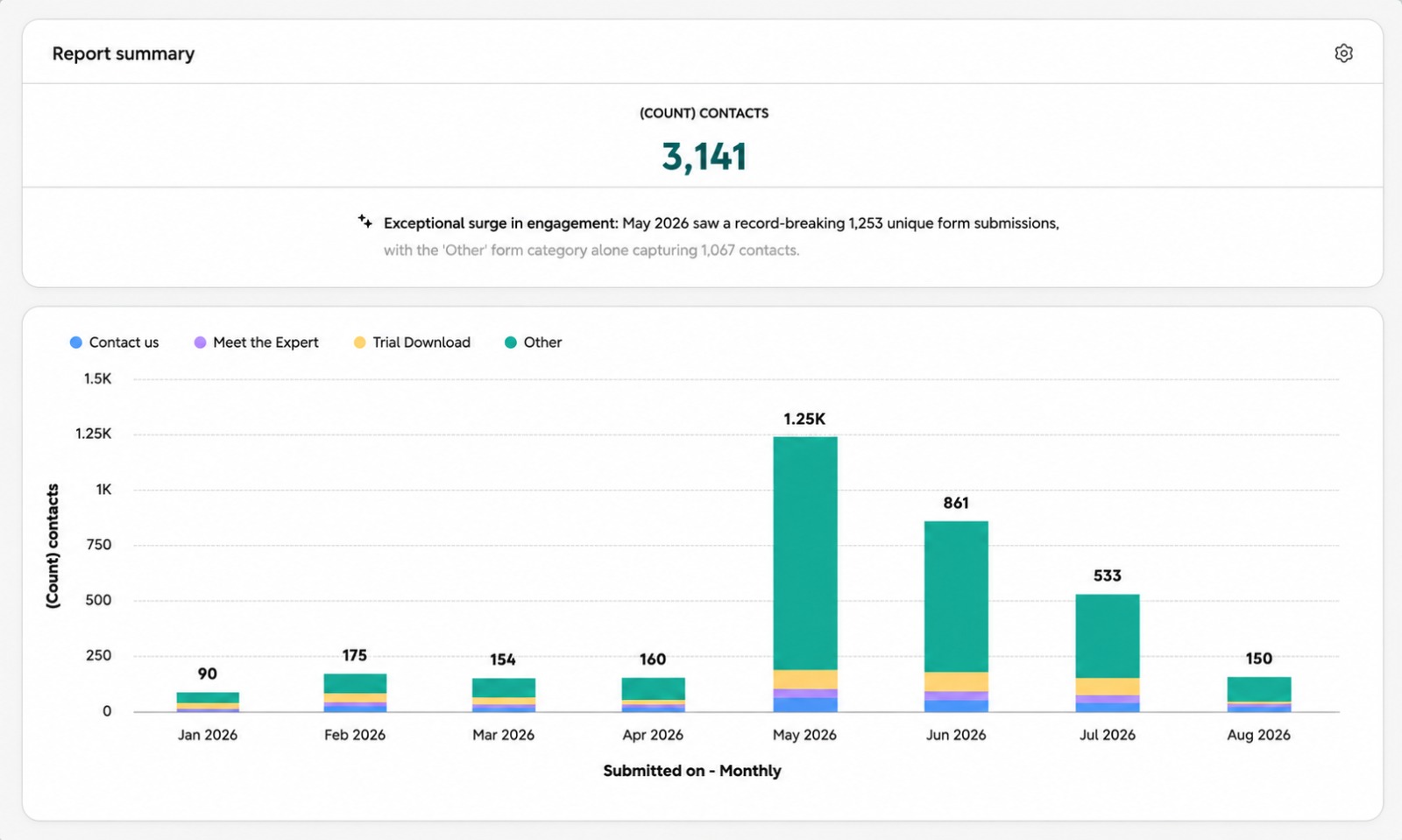
The client's HubSpot reporting provided the underlying data used to monitor inbound activity throughout the engagement.
The reporting showed substantial growth in monthly contact and enquiry activity during the highlighted performance period.
The results in this case study are based on the client's own reporting rather than estimated traffic projections or third-party benchmarks.
Where necessary, identifying information has been removed to maintain client confidentiality.
Why the Strategy Worked
The campaign did not depend on one isolated SEO tactic.
The improvement came from addressing several parts of the organic acquisition system together.
The Technical Foundation Made the Content Easier to Discover
A large website needs more than good content. Search engines need to be able to efficiently crawl, interpret, and index the right pages.
Existing Content Became More Commercially Useful
Instead of treating content volume as the primary growth lever, the campaign focused on improving pages that already had strategic value.
Industry Relevance Created Stronger Search Pathways
B2B buyers often search within the context of their specific industry.
A page built around simulation software for a particular sector can therefore be more valuable than a generic page about simulation technology.
International SEO Aligned Visibility With Market Demand
The client's international presence meant that search visibility had to be considered within geographic and language contexts rather than treated as one global market.
Conversion Optimization Connected SEO With Enquiries
The ultimate objective was not simply to increase impressions or rankings.
It was to turn organic visibility into meaningful business opportunities.
Ongoing Optimization Allowed the Strategy to Evolve
Because the engagement continues monthly, SEO priorities are not locked to a fixed project plan.
Performance data can inform the next round of technical improvements, content optimization, international work, and conversion opportunities.
This creates a continuous optimization cycle rather than a one-time SEO implementation.
The Bigger Lesson for B2B Companies
This case study highlights an important problem that many established B2B websites face.
When a company has hundreds or thousands of pages, the instinct is often:
"We need more content."
But more content is not always the answer.
Sometimes the bigger opportunity is already sitting inside the website.
Existing pages may need:
Better technical foundations
Stronger internal linking
Clearer search intent
Better keyword targeting
Improved information architecture
Stronger international signals
Better commercial positioning
More effective conversion paths
In other words, the question isn't always:
How much more should we publish?
It can be:
How much more value can we generate from what we already have?
For this B2B simulation software company, that distinction became particularly important.
The nine-month results demonstrate what can happen when an existing content asset is systematically optimized rather than simply expanded.
The ongoing engagement provides the framework for continuing that work as the website and search landscape evolve.
Key Takeaways
Content Volume Isn't the Same as SEO Performance - A large content library can still underperform if its technical and structural foundations aren't strong enough.
Existing Pages Can Represent Significant Growth Opportunities - Optimizing established industry and solution pages can sometimes create more value than continually publishing new content.
B2B SEO Should Be Measured Against Business Outcomes - Rankings and traffic are useful indicators, but enquiries provide a much closer connection to commercial performance.
International Websites Require a Market-Specific Approach - Global visibility does not automatically translate into visibility in the right market.
SEO and Conversion Optimization Should Work Together - Getting users to a website is only one part of organic acquisition. The website must also make it easy for relevant visitors to take the next step.
Ongoing SEO Creates Room for Continuous Improvement - A monthly SEO engagement allows the strategy to respond to new search opportunities, performance data, technical requirements, and business priorities rather than treating SEO as a one-time project.
What This Means for Your B2B Website
If your website already has substantial content but organic enquiries aren't growing at the same rate, publishing more content may not be the first step.
A technical and strategic SEO review can reveal where existing pages are losing visibility, where internal authority is being wasted, and where high-intent organic traffic is failing to convert.
The opportunity may already be there.
The challenge is finding it and turning it into measurable growth.
Unlike a one-off SEO project, an ongoing programme gives businesses the ability to keep identifying and acting on those opportunities as their market, website, and search landscape change.
Services Used: SEO
Related Case Studies: Explore more case studies to see how strategic SEO can improve organic visibility, acquisition, and business outcomes.
Want to Turn Your Existing Website Into a Stronger Organic Acquisition Channel?
If your B2B website already has strong content but organic enquiries aren't reflecting its potential, start with a clear understanding of what's holding it back.
A structured SEO audit can identify technical issues, content opportunities, internal linking gaps, search intent problems, and conversion barriers that may be limiting organic growth.
Get in touch to discuss your SEO growth opportunities.
B2B SEO Success: 3.5x Growth in Monthly Enquiries
How a B2B simulation software company scaled organic enquiries through strategic SEO, content optimization & international SEO.