
AI search engines do not choose sources in the same way. ChatGPT, Perplexity, and Google AI Overviews can all produce conversational answers, but each system uses different retrieval methods, source pools, ranking signals, and citation formats.
For marketers and business owners, this changes the goal. Ranking first in traditional Google Search is still valuable, but it does not automatically mean your page will appear in an AI-generated answer. To earn AI citations, your content must be crawlable, factually accurate, clearly structured, current, and genuinely useful for the question being asked.
This guide explains how AI search engines choose sources, why source overlap is often low across platforms, and what businesses should do differently for ChatGPT, Google AI Overviews, and Perplexity.
How AI Search Engines Choose Sources Visibility?
AI search visibility is the presence of your brand, website, or content inside AI-generated answers from platforms such as ChatGPT, Google AI Overviews, Perplexity, Gemini, Claude, and other answer engines.
Traditional SEO mainly measures rankings, impressions, clicks, and traffic. AI visibility adds new measurements:
Whether your domain is cited in an AI-generated answer
Which URL receives the citation
Which question or prompt triggers the citation
Which competitors are cited instead
Whether your brand is mentioned without a link
Which AI engine retrieves your content
How often your website appears across an important prompt set
A page can rank highly in Google but not receive an AI Overview citation. It can also be cited in Perplexity while ranking outside the top organic positions for the same keyword.
That is why AI visibility should be measured separately from standard keyword ranking.
The Three Engines Are Not One System
ChatGPT, Google AI Overviews, and Perplexity may look similar from the user's side. A user asks a question, receives a direct answer, and may see citations or supporting links.
But each product operates differently, and the sources each engine selects reflect those differences. Google AI Overviews sources are drawn from pages Google has already crawled, indexed, and evaluated within its own search infrastructure. Perplexity retrieves live web results and attaches citations directly to its answers. ChatGPT can draw on model training knowledge or pull current web results depending on how the experience is configured.
AI Engine | Main Retrieval Model | Typical Source Behaviour | Best Visibility Focus |
ChatGPT | Language model plus web retrieval in search-enabled experiences | Can combine model knowledge with current web results | Clear, current, credible information |
Google AI Overviews | Google Search index plus generative synthesis | Uses pages that Google can crawl, index, understand, and evaluate | Technical SEO, topic authority, answer quality |
Perplexity | Search-first answer engine with live retrieval | Retrieves web sources and attaches citations directly to answers | Focused, evidence-rich, up-to-date content |
The main lesson is simple: one generic "AI SEO strategy" is not enough.
A business might be visible in Perplexity but absent from Google AI Overviews. Another website may have excellent Google rankings but weak citation share in AI answers because its content does not provide clear, extractable explanations. Because each engine selects AI Overviews sources and citations through its own logic, visibility must be evaluated and optimised separately for each platform.
How ChatGPT Retrieves Training Data and Live Search Results
ChatGPT can answer questions through more than one knowledge pathway.
First, it can generate responses using patterns learned during model training. Second, in search-enabled experiences, it can retrieve and use current information from the web.
This distinction matters for publishers.
Training Knowledge Is Not a Live Search Index
A language model is not the same as a conventional search engine index.
Google Search constantly crawls, indexes, and ranks pages. When a page is published and indexed, it may become eligible to rank in search results.
A language model does not work in exactly the same way. New pages are not guaranteed to become part of model knowledge immediately after publication.
That means you should not rely on publishing alone. Your content should also be technically accessible and strong enough to appear in live retrieval systems when current web search is used.
Live Retrieval Creates a New Route to Visibility
When ChatGPT uses web search, newly published and recently updated content can be retrieved as a source. This gives businesses an opportunity to influence current answers without waiting for future model updates.
The best content for this environment is easy to verify and easy to quote.
Your article should:
Answer the main question early
Use headings based on real user questions
Define important terms clearly
Support claims with credible sources
Include original examples and practical guidance
Explain limitations honestly
Keep time-sensitive information updated
Make all important content available in crawlable HTML
For example, this is weak:
AI search is changing the future of content marketing.
This is stronger:
AI visibility should be tracked by engine and prompt because ChatGPT, Google AI Overviews, and Perplexity retrieve sources differently.
The second statement is more useful because it includes a specific explanation and an actionable recommendation.
What ChatGPT Needs From a Source
A good source for a ChatGPT search-grounded answer is not simply a page with the right keyword. It is a page that provides a clear answer to a specific question.
Content is more likely to be useful when it contains:
A concise answer near the top
Evidence-backed claims
Clear definitions
Expert explanations
First-party insights
Official documentation where relevant
Tables for comparisons
Steps for implementation
Updated information for changing topics
For B2B companies, this means generic service pages are not enough. Prospective buyers often ask detailed questions about technical risks, costs, implementation requirements, comparisons, performance, timelines, and outcomes.
Focused guides are more likely to help answer those questions.
How Google AI Overviews Select Sources
Google AI Overviews are part of the wider Google Search environment. Google can only use pages it can access, crawl, understand, and evaluate.
This means traditional SEO remains essential.
Your content needs to be indexable, well structured, relevant to the query, and useful enough to compete with other available sources.
However, Google AI Overviews do not simply take the first-ranked organic result and display it as a citation.
Google Rankings and AI Citations Are Different
Traditional Google Search ranks pages in a list. Google AI Overviews generate a synthesised response that may combine several sources.
A single AI Overview could use:
An official source for a factual statement
A specialist guide for a technical explanation
A comparison page for decision criteria
A current article for recent developments
A first-party case study for practical evidence
This creates an important difference:
Organic ranking position≠AI Overview citation probability\text{Organic ranking position} \ne \text{AI Overview citation probability}Organic ranking position=AI Overview citation probability
A page in position one may not be cited. A page ranking lower may receive the citation because it explains one part of the answer better.
For example, a broad article about SEO may rank strongly. But when someone searches for “SSR vs CSR for AI crawlers,” an AI Overview may prefer a focused article that explains:
Client-side rendering
Server-side rendering
Static site generation
Prerendering
JavaScript crawlability
How to test rendered HTML
Which implementation approach fits different website types
The more focused page may be more useful for the generated answer.
What AI Overviews Sources Need
Google AI Overviews sources typically need to contribute something valuable to the final answer.
Search Intent | Content Most Likely to Help |
Definition query | Explainer or glossary |
Technical problem | Practical technical guide |
Decision query | Comparison page or framework |
Current information | Official documentation or recently updated resource |
Evidence query | Original research or case study |
Action query | Checklist or implementation guide |
This is why topic clusters are important.
A website with only general service pages gives Google fewer useful assets to select. A website with a clear hub page, focused supporting articles, contextual internal links, expert authorship, and original examples is better positioned to become a source for multiple questions.
SEO Fundamentals Still Matter
Before attempting advanced AI visibility work, check the technical basics.
Your pages should not be blocked by robots.txt
Important content should not be hidden behind broken JavaScript rendering
Pages should not include accidental noindex tags
Canonical tags should point to the correct preferred URLs
XML sitemaps should include indexable pages only
Structured data should match the visible content
Key pages should receive contextual internal links
Redirects should avoid chains and loops
Content should satisfy the user’s search intent
If Google cannot crawl or understand your page, it cannot reliably use that page in standard search or AI Overviews.
How Perplexity Picks Sources
Perplexity is best understood as a search-first answer engine. It retrieves current web sources, generates an answer, and presents citations next to claims in the response.
That makes Perplexity useful for testing AI citations and learning which pages are being retrieved for your key questions.
Perplexity Uses Live Retrieval
Perplexity is built as a search-first answer engine. Unlike ChatGPT, which can draw on model training knowledge, Perplexity retrieves live web results for every query and attaches citations directly to its answers. Understanding how Perplexity picks sources is straightforward: the engine runs a real-time web search, selects pages that best address the query, and surfaces those as numbered citations within the response. This means content published or updated recently has a genuine opportunity to appear, as the selection logic relies on live retrieval rather than long-term ranking signals alone. While a new page may not appear immediately, results can change based on prompt wording, location, search date, account settings, available sources, content freshness, competitor coverage, and the type of query. Because how Perplexity picks sources is tied to live retrieval, marketers can use the platform to evaluate whether a page has enough value to be selected as a source right now. A practical process looks like this:
1. Identify a commercially relevant customer question.
2. Create a focused page that answers it completely.
3. Search the question in Perplexity.
4. Record whether your domain appears in the sources.
5. Review which competitor pages are cited.
6. Identify missing evidence, definitions, examples, or practical detail.
7. Improve the article.
8. Test the same prompt set regularly. This creates a measurable AI content optimised workflow and a faster feedback loop than waiting for long-term ranking movements.
How Perplexity Picks Sources for Answers
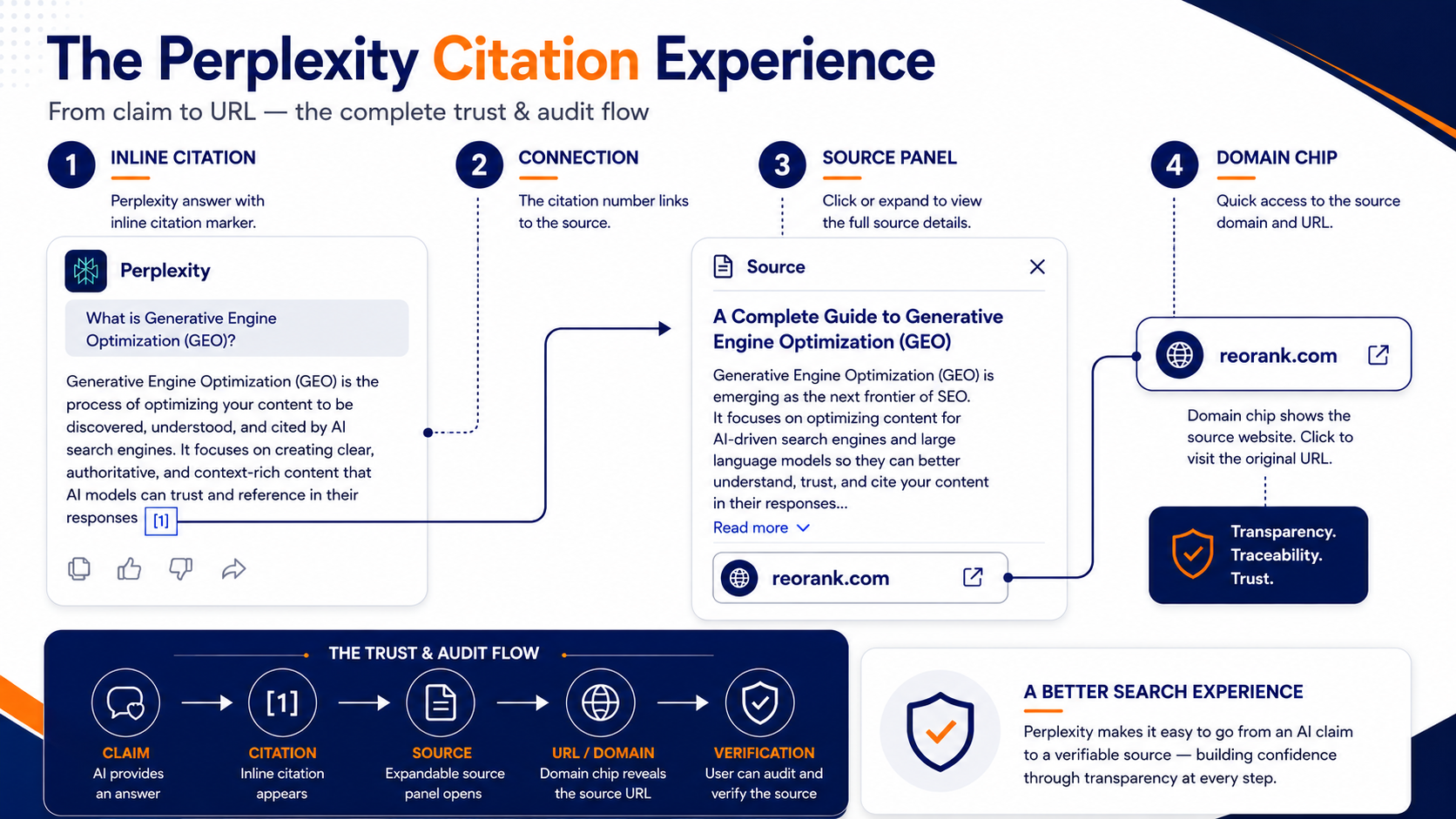
Perplexity needs sources that directly help answer the user’s question.
For example, consider this prompt:
Is my JavaScript website invisible to AI crawlers?
A useful source page should cover:
How AI crawlers differ from Googlebot
The effect of client-side rendering
How server-side rendering improves access to content
How to inspect source HTML and rendered output
When SSG, SSR, prerendering, or ISR is appropriate
How to verify that a fix worked
Any risks or trade-offs involved
A generic “AI SEO services” page is unlikely to answer this question as effectively as a detailed technical guide.
That is why Perplexity citations often create opportunities for content formats such as:
Technical implementation guides
Original research
Build logs
Checklists
Data-led comparisons
Expert explainers
Documentation-backed resources
How to Get Cited by Perplexity
If you want to improve your chances of being cited by Perplexity, focus on source usefulness rather than keyword repetition.
Use these practices:
Create one primary question per article
Put the direct answer in the introduction
Use descriptive headings
Add original examples and implementation details
Cite primary sources and official documentation
Keep changing information current
Publish content that has a unique point of view
Include useful tables, frameworks, and checklists
Avoid generic claims and unsupported statistics
Track results through a fixed prompt set
Perplexity is especially valuable because it can show which sources it used. That lets you compare your article against cited competitors and improve based on real visibility gaps.
Why Domain Overlap Between AI Engines Is Low
A domain cited by Perplexity may not be cited by Google AI Overviews. A page visible in Google AI Overviews may not appear in ChatGPT search results.
This is normal.
The systems have different indexes, retrieval workflows, ranking systems, freshness behaviour, and answer-generation processes.
The Same Question Can Produce Different Sources
Consider this question:
How should a B2B company prepare content for AI search?
Google AI Overviews may use pages with strong relevance in Google’s indexed ecosystem.
Perplexity may retrieve a mixture of specialist guides, current documentation, original research, industry resources, and community sources.
ChatGPT may generate an answer based on model knowledge, live web retrieval, or a combination of both.
The answer may look similar to a user, but the sources can be completely different.
This is why businesses should avoid depending on one platform or one content format.
Build Content for Multiple Retrieval Systems
The best approach is to build a portfolio of citation-worthy content.
Definitive guides for broad questions
Explainers for terminology and early-stage research
Technical guides for implementation
Checklists for practical execution
Comparisons for decision-stage users
Case studies for proof
Original research for unique data
Build logs for first-hand experience
Service pages for commercial search intent
Each format gives AI search engines a different type of useful source material.
A definitive guide may answer a broad question. A technical article may support one detailed claim. A case study may provide evidence. A comparison page may help users choose between options.
This is how topical authority compounds over time.
What to Do Differently for Each Engine
You do not need separate websites for ChatGPT, Google AI Overviews, and Perplexity.
You need one technically strong website, a clear content architecture, and an engine-specific measurement process.
For ChatGPT
Publish content that is clear, current, and easy to verify.
Use answer-first writing
Add question-led headings
Support claims with primary sources
Explain technical concepts simply
Include original insights
Update content when information changes
Avoid exaggerated or unverified claims
The goal is to become a reliable source when ChatGPT uses live web retrieval.
For Google AI Overviews
Strengthen traditional SEO while improving how extractable your content is.
Build complete topic clusters
Publish focused pages for specific questions
Improve internal links to important pages
Keep rendering, indexation, and canonicalisation clean
Use accurate structured data
Include expert analysis and original examples
Make each page contribute unique information
The goal is not only to rank in Google. It is to become a source that helps support a useful AI Overview.
For Perplexity
Use Perplexity as a live testing environment.
Build a fixed prompt set
Track citations by question and URL
Monitor competitor source selection
Improve pages that lack depth or evidence
Publish current, practical content
Add original data and examples
Measure citation share over time
The goal is to create pages that Perplexity can retrieve and cite for the questions that matter to your buyers.
How to Measure AI Visibility
Traditional rank tracking cannot fully measure AI search visibility.
A better framework includes the following.
Metric | What It Shows |
Citation share | How often your domain is cited compared with competitors |
Prompt coverage | How many key prompts include your domain |
Engine coverage | Where you appear across ChatGPT, Perplexity, and Google AI Overviews |
URL citation rate | Which individual pages are earning citations |
Competitor citation share | Which competitors are appearing instead |
Citation placement | Where your source appears in the answer |
Commercial prompt visibility | Whether you appear for buyer-intent questions |
Start with a manageable set of prompts. Include informational, technical, comparison, commercial, and branded questions.
Then track those prompts consistently. One result does not prove a trend. Repeated testing over time gives a more useful picture of your AI visibility.
Build AI Visibility With Evidence, Not Hype
The strongest AI SEO strategy is not keyword stuffing, a shortcut file, or a promise that a business will rank in every AI answer. Sustainable AI visibility comes from: technical accessibility so engines can crawl and retrieve your content, accurate and verifiable information, clear information architecture, search-focused content structure, original expertise, credible sources, transparent methodology, regular content updates, and consistent citation tracking across each platform. AI search engines choose sources that help them answer questions. Because ChatGPT, Perplexity, and Google AI Overviews sources are selected through different retrieval logic, your content needs to earn its place in each environment on its own merits. Your job is to make your website one of the clearest, most credible, and most useful sources available. Run a free AI visibility audit check to see where your business appears across ChatGPT, Perplexity, and Google AI Overviews and identify the competitor sources winning the AI citations you should own.
Google preferred sources
Get the next teardown first
Make REO Rank one of your Google preferred sources. Our analysis rides higher in Top Stories and carries a "Preferred" badge in AI Mode and AI Overviews, so you actually see the next one.
- About 5 seconds
- Free, no account
- Undo any time