
Ranking first on Google does not guarantee a citation in Google AI Overviews. AI-generated answers pull from multiple sources based on entity authority, topical relevance, content structure, and E-E-A-T signals not position alone. SEO teams must now track AI citation share separately from traditional rankings to understand their true search visibility.
For years, the goal was simple: rank #1, get the clicks. The logic held. The top organic result captured somewhere between 27% and 28% of all clicks, according to Backlinko's analysis of 4 million Google search results. Everything else was table scraps.
That logic is breaking down.
Google AI Overviews the AI-generated summaries that now appear above organic results for hundreds of millions of queries do not simply quote the #1 ranking page. They synthesize answers from multiple sources, weigh entity authority, assess content structure at the passage level, and make citation decisions that have very little to do with where a URL sits in the ten blue links below.
The implication is significant. A brand can hold the #1 position for a high-intent keyword and still be invisible inside the AI Overview that sits above it. Conversely, a site ranking on page two can earn a citation if its content is better structured, its entity signals are cleaner, and its passages are more directly quotable.
This is the core problem with how most SEO teams currently measure performance. They track rankings. Rankings are no longer the whole story.
This post explains exactly why AI Overview citation ranking has decoupled from traditional position data, what signals Google AI Overviews actually reward, and how SEO managers, marketing teams, and agency owners should adapt their measurement and strategy to match the new reality.
What Changed with Google AI Overviews
Google AI Overviews, formerly Search Generative Experience (SGE), launched broadly in the US in May 2024 and have since expanded to over 100 countries. For anyone working in AI Overviews SEO, understanding how this system differs mechanically from traditional search is the starting point for everything else.
A traditional SERP ranks pages. Google AI Overviews generate answers. The system reads across multiple pages, synthesizes a coherent response, and then attributes parts of that response to specific sources, displaying citation links alongside the generated text.
Several structural differences make AI Overviews behave differently from organic rankings:
AI-generated answers are retrieval-based, not rank-based:
The model retrieves passages that best answer the query, regardless of the overall authority of the page they come from. A highly authoritative domain can have a low-citability passage on a specific topic. A mid-authority site can have the clearest, most directly quotable answer.
Multiple citations appear per query:
A single AI Overview typically surfaces three to eight source citations. This means the winner-takes-most dynamic of traditional rankings softens slightly, but the bar for being cited at all is much higher and more opaque than simply ranking.
Responses are context-sensitive, not keyword-matched:
Google AI Overviews respond to the semantic intent behind a query, not the exact keywords on a page. This makes entity clarity and topical depth more important than keyword density, which has direct implications for how AI Overviews SEO strategy should be structured.
The net result: a page can rank well for a keyword and still fail to appear inside the AI Overview for that same query, because ranking and citation are now two separate systems with two separate sets of inputs.
Why Does Position #1 Not Guarantee AI Overview Citations?
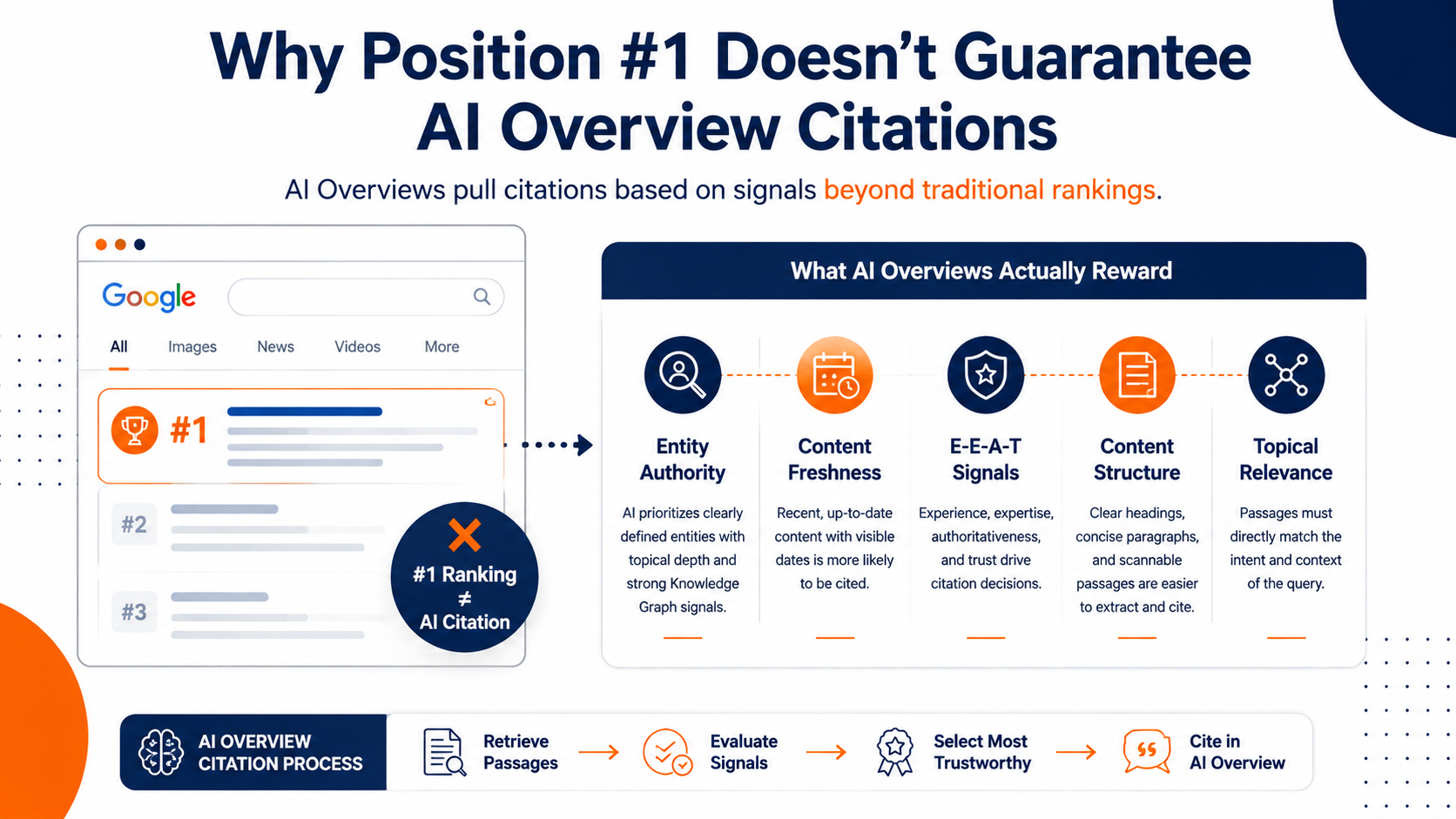
The disconnection between organic rank and AI Overview citation ranking comes down to five factors that Google's AI system weights differently from its traditional algorithm. Understanding why position 1 AI overview citations are not guaranteed requires looking at how the AI system makes retrieval decisions independently of where a page sits in organic results.
Does Google AI Overviews prioritize entity authority over domain authority?
Yes. Google AI Overviews are known to prioritize entity authority on how clearly and consistently a brand or author is recognized as an authoritative source on a specific topic over broad domain authority. A generalist site with a high Domain Rating may rank well for many queries but lack the topical depth required for the AI system to confidently cite it on a specific subject.
Entity SEO matters here:
A brand that has been disambiguated in Google's Knowledge Graph, is consistently mentioned alongside a defined set of topics, and has structured data confirming its expertise will earn citations that a high-DA generalist site will not.
How does content freshness affect AI Overview citations?
AI Overviews show a strong preference for recently updated content, particularly on topics where information changes. Pages that carry visible publication or update dates, and that reflect current facts and terminology, are more likely to be retrieved as citable sources. A page ranking #1 based on accumulated link equity may contain outdated information that the AI system actively avoids quoting.
What role does E-E-A-T play in AI Overview citation decisions?
Google's E-E-A-T framework (Experience, Expertise, Authoritativeness, Trustworthiness) is enforced more strictly in AI Overviews than in traditional rankings, making it a critical factor in any AI Overviews SEO strategy. The AI system is designed to cite sources that demonstrate real-world experience or verifiable expertise rather than simply rewarding pages that hold strong organic positions.
Author bylines, first-person case data, cited research, and external validation signals all increase a page's likelihood of being selected as a source. In practical terms, a page with a named expert author, original data, and references to primary research will consistently outperform an anonymous, generically written page in AI citation decisions, even if the latter ranks higher in traditional results.
Why does content structure matter for AI Overview citations?
AI Overviews operate at the passage level. The system lifts individual sentences and paragraphs, not whole pages. A well-ranking page with dense, unbroken prose may contain the right information but present it in a format the model cannot easily extract. Pages with clear headings, concise factual statements, and self-contained paragraphs are structurally more quotable.
Takeaway: AI Overview citation ranking is determined by entity clarity, content freshness, demonstrated expertise, and passage-level structure none of which are direct outputs of traditional rank tracking.
Why Does Traditional Rank Tracking Miss the AI Visibility Problem?
This is where many SEO teams are currently flying blind. The tools they rely on rank trackers, CTR reports, keyword position dashboards measure organic listing positions. They do not measure AI Overview appearances.
The problem has two dimensions.
Rankings and visibility are no longer the same thing:
A page can hold position #1 and still lose significant visibility if an AI Overview appears above it and cites three other sources. According to data from SE Ranking, AI Overviews now appear for approximately 13% of all queries in the US concentrated heavily on informational and high-intent commercial queries, precisely where SEO investment is highest.
CTR from ranked pages is changing:
When a Google AI Overview answers a query, users who find the answer sufficient have no reason to click through to organic results. Some queries that previously drove substantial organic traffic are now partially satisfied at the SERP level. Maintaining rank position does not protect against this CTR compression.
Traditional SEO tools do not track AI citations:
Tools like Semrush, Ahrefs, and Moz report organic rankings. None of them show whether your brand was cited in the AI Overview that appeared above your result. This creates a genuine reporting gap a brand can appear healthy in a rankings dashboard while steadily losing AI search visibility.
Takeaway: Reporting on rankings alone gives an incomplete picture of search performance. AI Overview citations require a separate measurement layer.
What Signals Do Google AI Overviews Actually Reward?
Understanding what earns citations is the foundation of any AI search visibility strategy. Based on observable patterns across AI Overview appearances, these are the signals that matter most:
Topical authority: Sites that cover a subject with depth and consistency through interconnected content, defined topic clusters, and content that answers questions at multiple levels of specificity are more likely to be recognized as authoritative sources on that topic.
Semantic relevance: Content that addresses the specific semantic context of a query, not just its keywords, performs better in AI retrieval. This requires understanding the entities, relationships, and concepts a query is really asking about.
Entity optimization: When a brand, author, or concept is clearly defined as an entity with schema markup, consistent naming, external references, and Knowledge Graph signals AI systems can confidently cite it. Ambiguous or poorly structured entities get skipped.
Structured headings and FAQ content: Content organized with clear H2 and H3 headings, and particularly content formatted as explicit questions and answers, aligns closely with how AI systems retrieve and attribute information.
Expert content with original insights: AI Overviews consistently favor content that includes data, real-world examples, or perspectives that cannot be found elsewhere. Generic content that recombines publicly available information without adding original value is less likely to be cited.
Trustworthy, well-referenced sources. Citations to primary sources, transparent authorship, and external validation all improve a page's perceived trustworthiness under E-E-A-T evaluation.
Takeaway: Earning AI Overview citations requires investing in topical depth, entity clarity, structured content, and original expertise not just ranking signals.
How Should SEO Teams Measure AI Search Visibility?
Since traditional rank tracking does not capture AI Overview appearances, teams need a supplementary measurement framework. The key metrics for AI search visibility are:
Citation Share:
The percentage of AI Overview appearances for a defined set of queries where your brand is cited as a source. Citation share is the AI-era equivalent of rank position. It answers: "When AI answers questions in our space, how often does it name us?"
AI Visibility Score:
A composite measure of how prominently and consistently a brand appears across AI answer engines, including Google AI Overviews, ChatGPT web search, Perplexity, and Microsoft Copilot.
Brand Mentions in AI Responses:
Tracking not just formal citations (linked sources) but unlinked brand mentions within generated answers. A brand named in an AI response without a citation link still earns trust-building visibility.
AI Referral Traffic:
Monitoring traffic originating from AI platforms in Google Analytics and other analytics tools. As AI search engines increasingly link out to sources, AI referral traffic is becoming a measurable channel.
LLM Monitoring:
Querying AI systems directly and systematically with target queries to track which sources are cited, how citation patterns change over time, and how competitors are performing.
ReoRank's AI Visibility Audit measures citation and mention share across ChatGPT, Perplexity, Gemini, and Google AI Overviews, benchmarks performance against competitors, and identifies the specific gaps blocked crawlers, missing schema, ambiguous entities that are preventing citations.
Takeaway: Citation share and AI visibility scores are the metrics that reveal what rank tracking cannot. Build them into your reporting now.
How Should Businesses Adapt Their SEO Strategy for AI Search?
Adapting to AI Overview citation ranking does not mean abandoning traditional SEO. It means extending it.
Technical SEO remains the foundation:
AI crawlers need to access your content before they can cite it. Blocked user-agents, JavaScript rendering issues, missing schema markup, and the absence of an llms.txt file all prevent AI engines from parsing your pages. A solid technical SEO baseline is a prerequisite for AI visibility, not a separate consideration.
Topic clusters build the topical authority AI systems reward:
Rather than targeting individual keywords, structure your content around comprehensive topic coverage. A pillar page supported by a network of semantically related content signals topical depth to both traditional search algorithms and AI retrieval systems.
Entity SEO converts brand ambiguity into citation confidence:
Define your brand, key authors, and core concepts as clear entities using schema.org markup. Connect those entities to the external Knowledge Graph through Wikipedia references, Wikidata entries, and consistent external mentions. When an AI model can confidently identify who you are and what you know about, it cites you. When it cannot, it cites someone else.
Restructure content for passage-level citability:
Audit your highest-value pages for quotability. Each section should begin with a clear, self-contained statement that answers a specific question. Avoid long preambles before the main point. Use structured headings that mirror the exact questions your audience asks.
Publish original insights and proprietary data:
AI systems are trained to prefer sources that add something to the conversation. Case studies, original research, expert commentary, and first-hand experience signals are all more citable than content that restates what already exists.
An AI SEO services program that integrates these elements technical access, entity clarity, structured content, and topical authority builds visibility that compounds across both traditional and AI search surfaces.
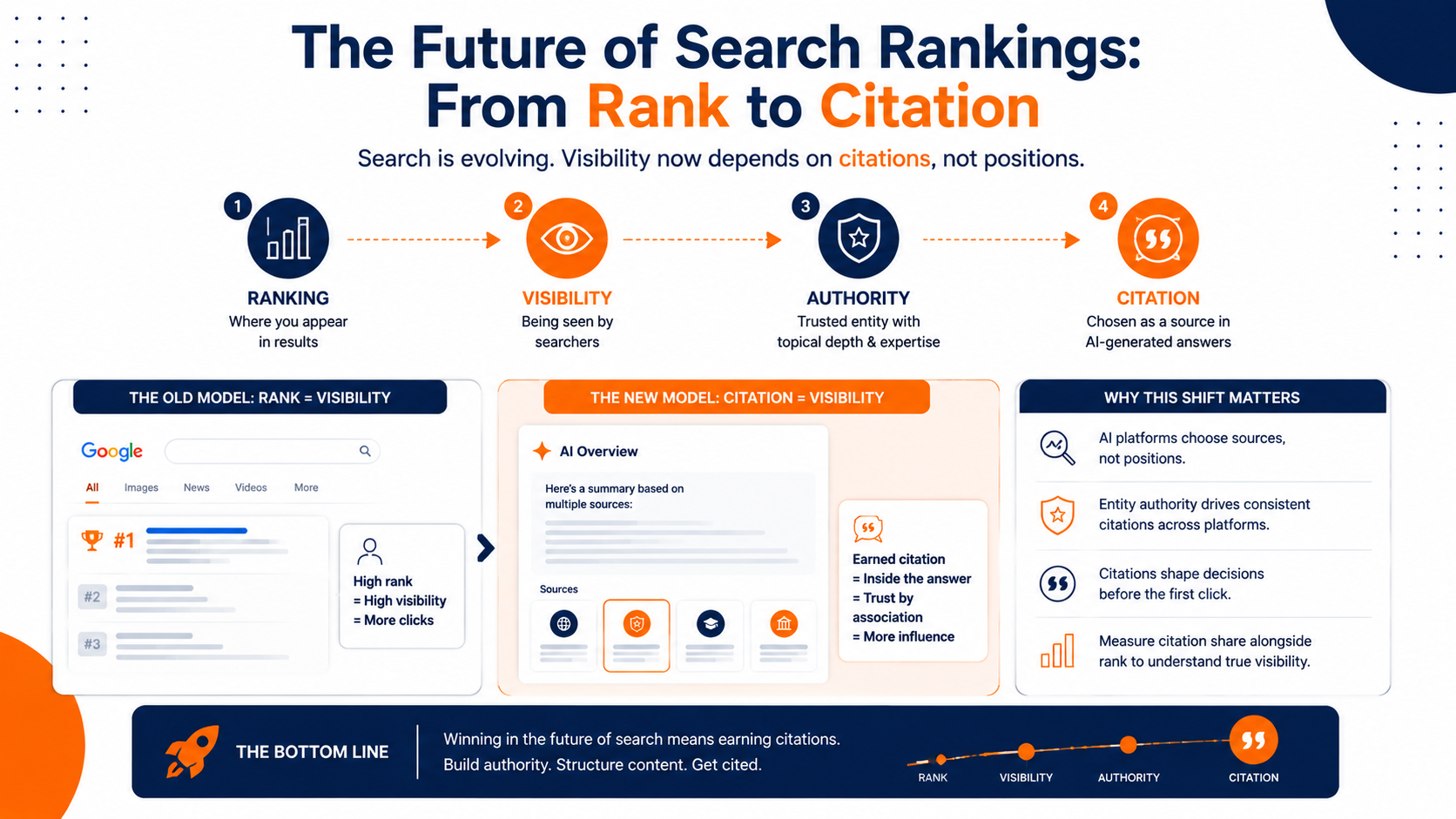
The Future of Search Rankings: From Rank to Citation
The trajectory of search is moving through a clear progression:
Ranking → Visibility → Authority → Citation
For two decades, ranking was the proxy for visibility. A high position in organic results meant users saw your brand. Visibility was a function of rank.
That proxy is weakening: As AI Overviews, ChatGPT web search, and Perplexity absorb a growing share of search interactions, visibility increasingly depends on whether AI systems choose to cite a brand not where it ranks in a traditional list. For teams investing in AI Overviews SEO, this shift demands a fundamental rethinking of what success looks like in search.
Authority was always the deeper signal: Brands that have built genuine entity authority, topical depth, and demonstrable expertise earn citations consistently across AI platforms, not just on one engine for one query. This kind of authority is harder to build and much harder for competitors to replicate quickly.
Citation is the new click:
The brands that earn a citation in an AI-generated answer sit inside the answer itself before the user decides whether to look at organic results. That position carries trust by association. It shapes the consideration set before the first click happens.
SEO strategies that optimize only for the ten blue links are optimizing for a surface that is shrinking in the queries that matter most. Adapting to AI Overviews SEO means tracking citation share alongside rank, building entity authority with the same rigor once reserved for link acquisition, and structuring content so AI systems can retrieve and attribute it with confidence.
Ranking #1 Is No Longer Enough Here's What to Do About It
The shift from traditional ranking to AI Overview citation ranking is not a future trend. It is already affecting click-through rates, organic traffic, and brand visibility for teams relying solely on position data to measure their search performance.
The brands that will maintain search visibility over the next three years are those that treat AI citation share as a primary KPI alongside traditional rankings, build entity authority and topical depth into their content strategy, and ensure their technical infrastructure is visible to AI crawlers not just Google's indexing bot.
Measuring where you stand today is the essential first step.
ReoRank's AI Visibility Audit gives you a point-in-time read of your citation share across ChatGPT, Perplexity, Gemini, and Google AI Overviews benchmarked against your competitors, with a prioritized roadmap for closing the gaps. Senior-led, measurable, and delivered within 30 days.
Book your AI Visibility Audit with ReoRank and find out exactly where you stand in AI search and what it will take to earn the citations your competitors are already getting.
Key AI Overview Citation Ranking Takeaways
Ranking first on Google does not guarantee a citation in Google AI Overviews.
For years, the goal was simple: rank #1, get the clicks.
The implication is significant.
This is the core problem with how most SEO teams currently measure performance.
A traditional SERP ranks pages.
Google preferred sources
Get the next teardown first
Make REO Rank one of your Google preferred sources. Our analysis rides higher in Top Stories and carries a "Preferred" badge in AI Mode and AI Overviews, so you actually see the next one.
- About 5 seconds
- Free, no account
- Undo any time